
PDILF – R Sharma – Application of NMR Relaxation to Determine the Hansen Solubility Parameter (HSP) of Particles
Application of NMR Relaxation to Determine the Hansen Solubility Parameter (HSP) of Particles – posterRavi Sharma1, Shin-Ichi Takeda2 Dave Fairhurst3, Stuart Prescott4, Terence Cosgrove5 1 Mageleka, Inc., Winter Park, Florida, USA 2 Colloid-Techno-Consultants,Ltd., Osaka, Japan3 Colloids Consultants, Ltd., Aiken, Fl, USA4 University of New South Wales, Australia5 Bristol University, UKContact Email: Ravi@mageleka.com The ease with […]
PDILF – R Tweedie – Particle characterization in formulation pharmaceutical particulate material quality control
Particle characterization in formulation, pharmaceutical particulate material quality control – presentationRichard J. Tweedie*Particulate Sensors Ltd, Newcastle-upon-Tyne, UK* richard.tweedie@particulatesensors.comwww.particulatesensors.com The twin business imperatives of increasing competitiveness, and reducing risk are common to all manufacturers, if not more so in the pharmaceuticals. This translates into increasing supply chain diversity and product complexity, with a constant pressure on […]
PDILF – D Elliott – The importance of particle dispersions in paint formulations and the need for better characterization methods
The importance of particle dispersions in paint formulations and the need for better characterization methods – posterDr David ElliottAkzoNobel Decorative Paints, Slough, UK Paints comprise dispersed particles of several kinds having wide ranges of particle size from tens of nanometres to hundreds of microns and a variety of shapes and aspect ratios. These include polymer […]
PDILF – D Skuse – Sustainable mineral/ microfibrillated cellulose composite formulation additives – Properties and uses
Sustainable mineral/ microfibrillated cellulose composite formulation additives: Properties and uses – presentationDavid SkuseFiberLean Technologies Limited, Par Moor Centre, Par Moor Road, Par, Cornwall, UK PL24 2SQEmail address – david.skuse@fiberlean.com When pulp and minerals are co-processed in aqueous suspension, the mineral acts as a grinding aid allowing cost effective production of fibrils. Furthermore, this processing uses […]
PDILF – S Ahmed – Vapour Sorption Techniques for Particle Engineering
Vapour Sorption Techniques for Particle Engineering – posterSabiyah Ahmed1, Meishan Guo1, Majid Naderi1, Manaswini Acharya1, and Daniel Burnett21Surface Measurement Systems Ltd., Alperton, London, HA04PE2Surface Measurement Systems Ltd., 2125 28th Street SW, Suite 1, Allentown, PA 18103, USAEmail: mnaderi@surfacemeasurementsystems.com Drug substances intended for drug delivery to the lungs typically require particle size reduction. High energy processes […]
PDILF – L Delforce – TiO2 nanoparticle dispersions studied by sedimentation analysis – Hansen Parameters vs DLVO interpretations
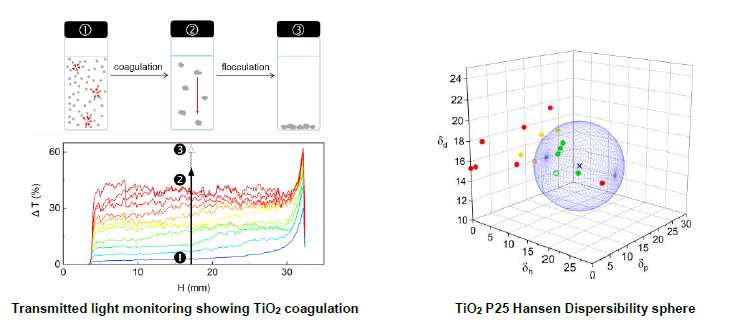
TiO2 nanoparticle dispersions studied by sedimentation analysis: Hansen Parameters vs. DLVO interpretations – poster Lucie Delforce1, Evamaria Hofmann2, Véronique Nardello-Rataj1, Jean-Marie Aubry11 Univ. Lille, CNRS, Centrale Lille, ENSCL, Univ. Artois, UMR 8181 – UCCS – Unité de Catalyse et Chimie du Solide, Lille, France2 Univ. Regensburg, Department of Physical Chemistry, 93051 Regensburg, GermanyContact Email: lucie.delforce@univ-lille.fr […]
PDILF – B Miller – The options available for particle characterisation of raw materials in formulation
The options available for particle characterisation of raw materials in formulationBrian MillerMeritics Ltd., Leighton Buzzard, LU7 4GPbm@meritics.com Characterising the raw materials used in formulating products is a vital step to understanding and controlling the process. As technologies move forward so do measurement techniques and there are now an increasing number of methods for characterising these […]
PDILF – S Abbott – Particle Dispersion for Formulators
Particle Dispersion for FormulatorsProfessor Steven Abbottsteven@stevenabbott.co.uk For too long, the particle formulation community has had to work with inadequate formulation tools. Things are now changing for two reasons. First, a lot of the knowledge is available in free apps, demonstrated live during the talks. Second, the community is realising that the solubility science approach is […]
PDILF – M Mohammadi – Colloidal Refractometry for Microstructure Characterization of Particle Dispersions
Colloidal Refractometry for Microstructure Characterization of Particle Dispersions – posterMansur S. MohammadiBiruni Associatesmansur.sultani@gmail.com This poster introduces a new structural probe for colloidal liquids in their neat unperturbed state. The technique combines two recent advances in refractometry – a generalised equation for the refractive index of particulate systems which contains the size and the volume concentration […]
PDILF – B Hinchliffe – Challenges of assessing number-based particle concentration and the development of a quantitative method using DCS
Challenges of assessing number-based particle concentration and the development of a quantitative method using DCS – posterBeth A. Hinchliffe1, Annhelen Lu2, Mohammed Alkattan2, Caterina Minelli11 National Physical Laboratory, Hampton Road, Teddington, Middlesex, TW11 0LW, UK2 OxSonics Therapeutics, The Magdalen Centre, Oxford Science Park, Oxford, OX4 4GA beth.hinchliffe@npl.co.uk Number-based particle concentration is an important attribute of industrial […]