

It’s All In The Mix – 03 The Role of the Baking Process in the Formation of Wafer Structure
The role of the baking process in the formation of wafer structure Ramana Sundara, Nestle Product Technology Centre, UK This research study is based on two precepts: firstly, wafer is foam, a cellular solid of dried gelatinised starch containing gas cells. Secondly, wafer texture is a result of competition between the developing gas phase and […]
It’s All In The Mix – 02 Physical Modification of Hydrocolloids for New Functionality
Physical modification of hydrocolloids for new functionality John Mitchell, Biopolymer Solutions Ltd The hydrocolloid xanthan gum is modified by extrusion processing. The modified material behaves as a polyelectrolyte particle showing excellent dispersibility in water and a strong salt dependence of the dispersion viscosity. Comparison of the temperature dependence of the viscosity with the temperature of […]
It’s All In The Mix – 06 Particles R Us
Particles ”R” Us – SCF engineering solution for product performance Lyn Daintree, CrystecPharma In the last twenty years significant progress has been made in the application of supercritical fluid crystallisation of active molecules. This presentation provides an overview of the application of an anti-solvent supercritical fluid technology in designing product qualities such as polymorphic purity, […]
It’s All In The Mix – 08 Processing Nanoemulsions
Processing of nanoemulsions Laura Lee & Ian Norton, University of Birmingham The purpose of this work was to compare the production of oil-in-water nanoemulsions using a Microfluidizer and a high pressure valve homogeniser (HPH) for food emulsions. This work systematically compares the variables that control the energy dissipation rate and final droplet size of the […]
It’s All In The Mix – 07 Effect of Sugars on Mixed Biopolymer Systems
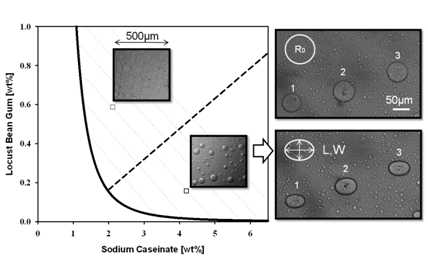
Effects of sugar on mixed biopolymer systems Asja Portsch, Fotios Spyropoulos & Ian Norton, University of Birmingham The aim of this work is to better understand the structuring processes in low fat dairy emulsions. Model sodium caseinate-galactomannan aqueous two-phase systems (NaCAS-GM ATPS) differing in GM-type (locust bean gum (LBG), tara gum (TG), guar gum (GG), […]
It’s All In The Mix – 05 Formulation Engineering of Pickering Emulsions
Formulation engineering of “Pickering Emulsions” – Novel functionalities and potential applications Tom Mills & Fotios Spyropoulos, University of Birmingham The fact that emulsions can be stabilised by finely divided solid particles was first reported over a century ago. The discovery of this type of emulsions is usually ascribed to Pickering (hence the term “Pickering emulsions”) […]
It’s All In The Mix – 04 Sustainable Manufacturing for the Process Industry
Sustainable manufacturing for the process industry: a competition for feasibility and collaborative R&D funding Darren Ragheb, Chemistry Innovation Knowledge Transfer Network The Technology Strategy Board is to invest up to £5m in feasibility projects and collaborative research and development to encourage the development and commercialisation of innovative approaches to sustainable manufacturing in the process industry. […]
It’s All In The Mix – 00 Introduction

The Royal Society of Chemistry’s Formulation Science and Technology Group’s (RSC FSTG) Conference at the University of Birmingham, Department of Chemical Engineering. This one day conference focused on the importance of processing on Formulation performance as illustrated by a number of examples across business areas exemplified by food and pharma. It will highlighted importance of […]
It’s All In The Mix – 01 Controlling Product Microstructure
Controlling product microstructure Peter Graham, Unilever R&D Consumers perceive differences in product structure via their visual appearance, rheology & texture, dilution and dissolution characteristics, and make purchasing choices accordingly. During manufacture liquid structure formation is governed by the underlying phase and colloidal behaviour, and the transient temperature, flow and concentration conditions which exist. Of course […]